
303 entries
Risk
Types of risk and how they are measured — VaR, CVaR, expected shortfall, stress testing, hedging.
- Rollover Refinancing Risk The danger that maturing debt cannot be renewed at acceptable rates, or cannot be refinanced at all, forcing an entity into distress.
- Rollover Risk The risk that a borrower cannot refinance or renew maturing short-term debt, forcing default or a distressed refinancing at unfavorable terms.
- Scenario Analysis Evaluating portfolio returns under a discrete set of coherent economic scenarios to test strategy robustness across different macro futures.
- Scenario Analysis Scenario analysis is a structured method of assessing portfolio losses under specific, named market conditions by explicitly defining key variables and calculating outcomes across different scenarios.
- Second-Order Risk: Gamma and Convexity Gamma and convexity measure how a position's value curve bends, revealing risk that linear (delta/duration) estimates miss—critical when volatility spikes or rates move sharply.
- Selling Covered Calls as a Partial Hedge How covered calls reduce effective cost basis through premium income while providing limited downside protection for stock investors.
- Semi-Variance A downside-focused risk measure that squares only the returns below a target threshold, ignoring positive deviations and treating upside differently from downside.
- Sequence of Returns Risk in Retirement Why the order of good and bad market years matters for retirees withdrawing from a portfolio, even when average returns are identical.
- Sequencing Risk in Retirement Withdrawals Sequencing risk in retirement explains why early investment losses hurt retirees more than late ones, even with identical average returns. A key threat to portfolio sustainability.
- Settlement Risk Settlement risk is the danger that one side of a financial transaction will be settled (payment delivered) while the other side is not, leaving one party with a loss.
- Sharpe Ratio Limitations as a Risk Measure The Sharpe ratio penalises upside and downside volatility equally, assumes normal returns, and can be manipulated with options. Learn its blind spots and alternatives.
- Single-Counterparty Credit Limits Regulation How the Federal Reserve's SCCL rule restricts bilateral exposures between large banks and any single counterparty, with different thresholds for G-SIBs.
- Solvency II Solvency Capital Requirement Explained Solvency II's Solvency Capital Requirement (SCR) sets a minimum capital buffer for EU insurers, calculated via standard formula or internal models, to cover unexpected losses.
- Sovereign Risk Sovereign risk is the probability that a national government will default on its debt obligations or be unable to pay them in full or on time.
- Sovereign Risk vs Country Risk Learn the distinction between sovereign risk—the chance a government defaults on its own debt—and country risk, the broader set of risks affecting all businesses and investors in a jurisdiction.
- Spectral Risk Measure A class of risk measures that weights tail losses according to investor risk aversion, generalizing Expected Shortfall.
- Spread Risk The mark-to-market loss when credit spreads widen, reducing the value of bonds and loan portfolios regardless of default.
- Stack-and-Roll Hedge A hedging strategy using repeated short-dated futures contracts rolled forward to manage long-term price exposure.
- Standardised Approach to Credit Risk Under Basel III How banks assign fixed risk weights to loans using the standardised approach, and when this simpler method is required instead of internal models.
- Stop-Loss Order An automatic sell order that executes when a position falls to a predetermined price, limiting losses on a trade.
- Stress Testing Subjecting a portfolio to extreme hypothetical scenarios to assess resilience and capital adequacy under adverse conditions.
- Stress Testing Stress testing is a risk assessment method that measures portfolio losses under severe but plausible market conditions, explicitly exploring tail scenarios and model breakdowns.
- Supervisory Review Process Basel Pillar 2 framework under which bank supervisors assess whether an institution's capital cushion exceeds regulatory minimums and impose add-ons where needed.
- Systematic Risk Systematic risk — also called market risk — is the exposure to broad, economy-wide factors that move all or most assets in the same direction. It cannot be eliminated through diversification.
- Systemic Risk Systemic risk is the danger that the failure of one institution or a shock to one part of the financial system will cascade through interconnected markets and institutions, threatening the stability of the entire system.
- Systemic Risk Buffer Requirement National regulators can impose a systemic risk buffer on institutions whose failure would harm the broader financial system. Learn what triggers the buffer and how it works.
- Tail Dependence The tendency of two or more assets to move together in extreme market conditions, when volatility is highest and diversification fails.
- Tail Dependence and Copulas in Risk Modeling How tail dependence and copulas model extreme losses in portfolios, revealing correlation breakdowns during market stress that linear measures miss.
- Tail Dependence Coefficient A measure of the probability that two assets experience extreme losses simultaneously, revealing correlation hidden by normal-market statistics.
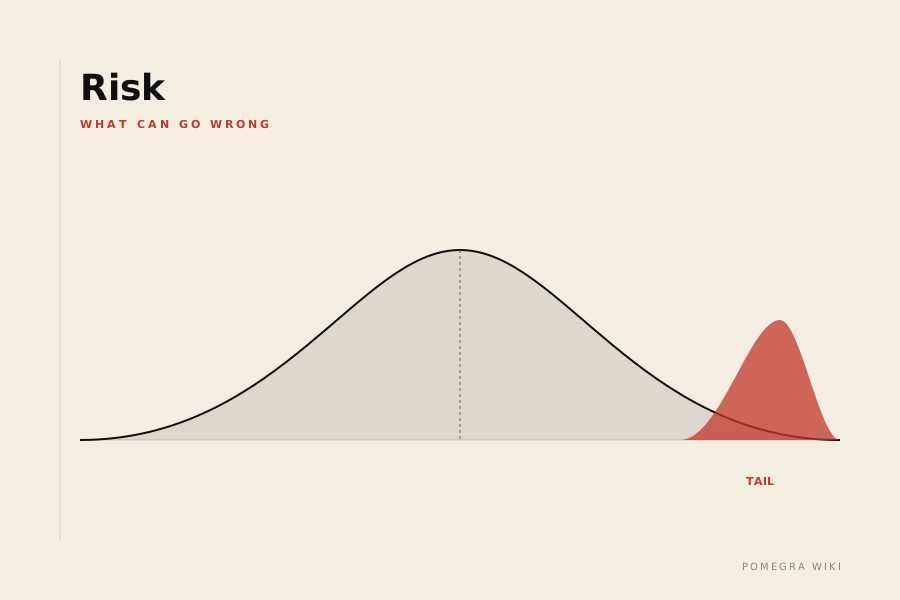
- Tail Risk Tail risk is the exposure to rare, extreme losses that lie in the tails of the probability distribution — events much worse than the historical average or expected value.
- Tail Risk Hedging Protecting portfolios against rare, extreme market dislocations using options and derivatives.
- Tail Risk: Definition and Examples Tail risk definition and examples explain extreme loss events where realized losses far exceed normal statistical predictions.
- Technology Risk Operational disruption to financial services from system failures, outdated infrastructure, algorithmic errors, or cyber breaches.
- Term Structure of Volatility and Risk Horizons How volatility varies across different time horizons and why forecasting multi-period risk requires understanding term structure of volatility, not just daily fluctuations.
- Tier 1 Capital Tier 1 capital is the highest quality capital a bank holds — primarily common equity and retained earnings — that is fully available to absorb losses before the bank faces regulatory restrictions or insolvency.
- Tier 2 Capital Tier 2 capital is supplementary capital — mainly subordinated debt, loan loss reserves, and other instruments — that ranks below Tier 1 but above unsecured creditors and deposits in a bank's capital structure.
- Time-Horizon Risk for Short-Term Investors Why short-term investors face greater effective risk from volatility than long-horizon investors holding the same assets.
- Total Loss-Absorbing Capacity The minimum quantity of debt and equity a globally systemically important bank must maintain to absorb losses and recapitalise in resolution.
- Tracking Error as a Risk Measure Explained Tracking error risk explained: how active funds are measured against their benchmark, calculated from return variance, and interpreted as manager skill or drift.
- Tracking Error as an Active Risk Measure Tracking error quantifies how much an active portfolio deviates from its benchmark. Learn what high and low tracking error means for risk management and performance attribution.
- Tracking Error Volatility The standard deviation of a portfolio's returns relative to a benchmark, measuring active management drift.
- Transaction Risk in Currency Exposure How exchange-rate moves between contract signing and settlement create gains or losses on cross-border trade receivables and payables.
- Transfer Risk The obstacle to converting or moving funds across borders when a foreign borrower cannot access its country's currency supply, regardless of solvency.
- Using Futures to Hedge a Small Portfolio How index futures can hedge small portfolios, despite minimum contract sizes. Explains cost barriers, scaling solutions, and when alternatives work better.
- Using Put Options to Hedge a Long Stock Position How a protective put option limits downside risk on individual stock holdings, with guidance on strike selection, cost-benefit trade-offs, and expiry timing.
- Value at Risk for Small Portfolios VaR limitations for small portfolios: few positions break diversification assumptions. Learn when VaR fails and how to adjust.
- Value-at-Risk Value-at-risk (VaR) is a measure of the maximum loss a portfolio is expected to suffer over a given time horizon at a specified confidence level, widely used in risk management and financial regulation.
- VaR Backtesting The process of validating a Value at Risk model by comparing predicted loss thresholds to actual trading results over a historical period.
- Vega Hedging in an Options Portfolio How traders hedge vega exposure by buying or selling options to neutralise sensitivity to implied volatility changes.
- Vendor Risk Operational and financial exposure arising from dependence on third-party service providers and outsourcing arrangements.
- Volatility Clustering The empirical tendency for periods of high price volatility to cluster together, with large market moves typically followed by further large moves rather than mean reversion.
- Volatility Clustering and Its Risk Implications Volatility clustering shows that large price moves tend to follow large moves. Learn how this shapes short-term risk models and why standard deviations fail.
- Volatility Clustering Explained With Examples Volatility clustering is the empirical pattern where large price swings tend to follow large price swings, challenging constant-volatility risk models.
- Volatility Drag on Leveraged Portfolios How daily rebalancing in leveraged ETFs causes returns to fall below the leveraged index return during volatile, sideways markets.
- Volatility Hedging Strategies and instruments used to reduce exposure to price fluctuations in underlying securities or portfolios.
- Volatility Risk Exposure of options and structured products to unexpected shifts in implied volatility, independent of underlying asset moves.
- Volatility Targeting Explained Volatility targeting strategy explained: scale position size inversely with realized volatility to maintain constant portfolio risk over time.
- Volcker Rule Proprietary Trading Restrictions The Volcker Rule restricts banks with deposit insurance from proprietary trading while permitting market-making. Learn the compliance tests and exemptions.
- What Happens to Portfolio Risk When Correlations Spike When correlations spike, diversification benefits collapse and portfolio risk rises sharply. Learn why asset correlations converge in market stress.
- White Swan A white swan is a foreseeable positive surprise — an unexpectedly good outcome from known or expected conditions that materialize more favorably than base-case assumptions.
Looking for something specific? Use the search box up top, or browse every category →