
328 entries
Monetary policy
Central banking and money-supply mechanics — interest rates, QE, aggregates, reserve currencies.
- Main Refinancing Operations The ECB's weekly one-week secured lending operations that set the benchmark short-term interest rate for the eurozone.
- Makeup Strategy in Monetary Policy Makeup strategy monetary policy commits a central bank to offset prior inflation or output misses, distinguishing it from inflation targeting and FAIT.
- Managed Float Exchange Rate: How It Works How central banks intervene in managed float systems to smooth volatility while allowing market forces to set the baseline exchange rate.
- Mandate Hierarchy in Monetary Policy Frameworks How central banks rank competing objectives—price stability, employment, financial stability—when policy goals conflict, with cross-country examples.
- Marginal Lending Facility The ECB's standing overnight credit facility that sets the ceiling rate for eurozone short-term borrowing.
- Market Segmentation Theory The theory that different maturity segments of the bond market operate independently, determined by institutional demand rather than arbitrage.
- Modern Monetary Theory Modern Monetary Theory (MMT) is an economic framework arguing that governments with sovereign currencies can pursue full employment without fiscal constraints by having central banks finance spending.
- Monetary Base The monetary base is the foundation of the money supply—all central bank money, including cash in circulation and bank reserves.
- Monetary Policy Monetary policy is the set of tools a central bank uses to influence the supply of money and credit in an economy, steering inflation, employment, and growth.
- Monetary Policy Committee The governing body that votes on benchmark interest rates and monetary policy decisions, balancing central bank independence with democratic accountability.
- Monetary Policy Framework Review The formal process central banks use to reassess and update their monetary policy objectives, tools, and public guidance.
- Monetary Policy Lag The delays between a central bank rate change and its full effect on employment and inflation.
- Monetary Policy Reaction Function A central bank's systematic rule mapping inflation, unemployment, and growth to interest-rate decisions.
- Monetary Policy Rules Systematic, rule-based approaches to setting central bank policy rates based on economic conditions, rather than ad hoc judgement.
- Monetary Policy Signal Trading Trading strategy that anticipates market moves by interpreting central bank forward guidance, policy signaling, and macroeconomic commentary for alpha opportunities.
- Monetary Policy Tools Monetary policy tools are the techniques a central bank uses to control the money supply, interest rates, and financial conditions to achieve inflation and employment objectives.
- Monetary Policy Tools for Small Open Economies Monetary policy tools for small open economies face unique constraints from exchange-rate exposure and capital flows. How do central banks adapt?
- Monetary Policy Transmission Monetary policy transmission is the process by which changes in central bank rates ripple through the financial system and real economy, affecting employment, inflation, and growth.
- Monetary Policy Transmission Mechanism How monetary policy transmission mechanism channels work: interest rate, asset price, credit, exchange rate, and expectations pathways from central bank to economy.
- Monetary Transmission Mechanism How central bank actions affect real economic activity and inflation through multiple channels.
- Money Growth Targeting A monetary policy framework setting explicit growth targets for monetary aggregates like M2.
- Money Market Mutual Fund Liquidity Facility A Federal Reserve lending programme that lets banks post money-market securities as collateral for loans, preventing runs on money-market mutual funds during credit crises.
- Money Multiplier The money multiplier is the factor by which the monetary base gets expanded into the broader money supply through repeated lending and depositing in the banking system.
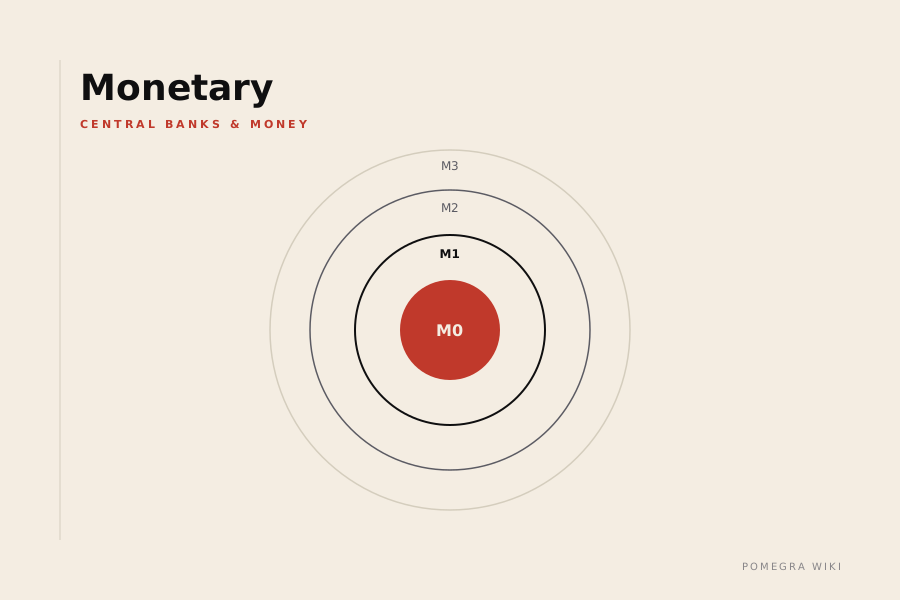
- Money Supply Aggregates The M0-through-M3 taxonomy classifying the money supply by liquidity and use, from physical cash to broad financial assets.
- Money Supply Contraction and Recession Understand how sharp declines in broad money supply precede or deepen recessions through spending constraints, credit contraction, and falling demand.
- Money Supply Dynamics in a Small Open Economy Small open economies lose independent control of money supply when exchange rates are fixed or capital flows unrestricted—a constraint that shapes their monetary policy choices.
- Money Supply Growth and Inflation Lag Inflation typically lags money supply growth by 12 to 24 months; the delay reflects time needed for new money to cycle through the economy and raise prices.
- Money Supply Growth Rate Targeting Explained Why central banks set explicit M-aggregate growth targets, the monetarist logic behind them, and why most abandoned the policy by 2000.
- MZM (Money Zero Maturity) A broad US money aggregate that covers all monetary instruments redeemable at par value on demand without penalty.
- Natural Rate of Interest The theoretical real interest rate at which saving and investment equilibrate without pressure on inflation or deflation.
- Negative Interest Rate Policy Setting the policy deposit rate below zero to penalise excess reserves and force banks to lend and spend rather than hoard cash.
- Negative Interest Rate Policy: How It Works and Its Limits How central banks implement negative interest rate policy, the transmission mechanism to the real economy, and the practical constraints that limit how far below zero rates can go.
- Negative Interest Rates Interest rates below zero, where depositors and investors must pay to hold cash or bonds, used by central banks to stimulate a depressed economy.
- Negative Interest Rates and the Money Supply How sub-zero policy rates affect banks' reserve-holding and lending behavior, and why negative interest rates may not reliably expand the money supply.
- Negative Interest Rates: How Central Banks Use Sub-Zero Policy Rates How central banks push policy rates below zero, the mechanics of negative interest rates on bank reserves and deposits, and the limits that prevent deeper cuts.
- Negative Real Interest Rates: What They Mean for Borrowers and Savers When inflation exceeds nominal interest rates, real rates turn negative. This shifts purchasing power from savers to borrowers and becomes a hidden policy tool for central banks.
- Neutral Interest Rate The policy interest rate at which the central bank neither stimulates nor restrains the economy once inflation is at target.
- Neutrality of Money The economic proposition that money-supply changes affect prices but not real output or employment in the long run.
- Nominal Anchor The target for inflation, money growth, or exchange rate that a central bank commits to, anchoring inflation expectations.
- Nominal GDP Targeting A central bank framework that targets the level or growth rate of nominal output rather than inflation or real growth alone, allowing automatic accommodation of supply shocks.
- Open Market Operations: How Central Banks Steer Short-Term Rates Open market operations (OMOs) are purchases and sales of securities by central banks to control money supply and short-term interest rates. Learn how permanent and temporary OMOs differ.
- Open-Market Operations Open-market operations are purchases and sales of securities by a central bank to influence the money supply and interest rates.
- Operational Target vs Intermediate Target in Monetary Policy Central banks set two layers of targets: the operational target they control directly and intermediate targets they monitor as policy signals.
- Optimal Control Approach to Monetary Policy How central banks use optimal control techniques to minimize a loss function across inflation, unemployment, and other objectives over multi-year horizons.
- Optimum Currency Area Criteria Mundell's framework for evaluating when countries or regions should share a currency, based on labor mobility, trade integration, fiscal coordination, and symmetric shocks.
- Original Sin (International Finance) The structural constraint preventing most emerging-market countries from borrowing internationally in their own currency, forcing reliance on foreign denominations.
- Outright Monetary Transactions The European Central Bank's conditional sovereign bond purchase programme designed to eliminate currency convertibility risk and stabilise the eurozone during debt crises.
- Outside Money Money created by government or the central bank that functions as a net asset to the private sector.
- Overnight Index Swap Rate and Monetary Policy Expectations Overnight index swap rates reflect market expectations for future central bank policy rates and serve as a real-time gauge of where interest rates are expected to move.
- Overnight Rate Mechanism The interest rate on unsecured overnight lending between banks, a fundamental rate that anchors short-term money market pricing.
- Overnight Rate vs Prime Rate The overnight rate is set by central banks; the prime rate is what banks charge customers. Understand the difference and how fed policy flows through to your mortgage.
- Parallel Exchange Rate and Black Market Currency Why official and unofficial exchange rates diverge under capital controls or currency shortages, and the economic distortions that follow.
- Payment System Stability Payment system stability is the responsibility of central banks to ensure that the infrastructure for transferring money between banks and to the public works reliably and safely.
- People's Bank of China The People's Bank of China is the central bank of China, managing monetary policy, the yuan, and the world's second-largest economy under state control.
- Permanent Open-Market Operations Permanent open-market operations are outright purchases or sales of securities by a central bank with no agreement to reverse the transaction.
- Policy Normalization Framework: How Central Banks Exit Accommodation How central banks sequence rate hikes, balance-sheet runoff, and corridor normalization when unwinding crisis-era monetary accommodation.
- Policy Rate vs Market Interest Rate Policy rate is what a central bank sets; market interest rates are determined by supply and demand for credit. They often diverge, affecting how policy transmits to the real economy.
- Policy Rate vs Market Interest Rate: What Is the Difference? How the overnight rate a central bank controls transmits imperfectly to mortgages, corporate bonds, and savings rates through bank intermediation and risk premia.
- Policy Space in Central Bank Frameworks How central banks measure policy space — the room to cut interest rates — and strategies to rebuild room when rates hit the lower bound.
- Preferred Habitat Theory The theory that investors will move between maturities only if offered a sufficient yield premium, explaining both the yield curve shape and segmentation.
Looking for something specific? Use the search box up top, or browse every category →