
328 entries
Monetary policy
Central banking and money-supply mechanics — interest rates, QE, aggregates, reserve currencies.
- How Interest Rate Hikes Affect Mortgage Rates How interest rate hikes affect mortgage rates: the transmission chain from central bank decisions to fixed and adjustable mortgage costs for borrowers.
- How Interest Rate Hikes Affect Savings Account Yields How interest rate hikes affect savings accounts reveals why bank deposit rates lag central bank increases, and what savers can expect during tightening cycles.
- How Loan Repayment Destroys Money When a borrower repays a bank loan, the corresponding deposit is extinguished, reducing broad money in the economy. Loan repayment destroys money through the mechanics of double-entry accounting.
- How Negative Interest Rates Squeeze Bank Profitability Negative interest rates compress bank profitability by reducing net-interest margins when central banks charge banks to hold reserves, while negative rates for depositors remain politically difficult.
- How Open Market Operations Change the Money Supply Open market operations expand or contract the money supply as central banks buy and sell government securities, adding or removing reserves from the banking system.
- How Quantitative Tightening Reduces the Money Supply How quantitative tightening reduces money supply by shrinking the central bank balance sheet, lowering reserves and tightening financial conditions.
- How Rate Hikes Affect a Home Equity Line of Credit Why HELOC payments rise quickly after rate hikes, unlike fixed-rate mortgages, and how draw vs. repayment phases differ.
- How Reserve Requirements Affect Money Creation How reserve requirements affect money creation: the reserve ratio constrains the money multiplier and determines how much banks can lend.
- How Rising Interest Rates Affect Credit Card Debt Learn how rising interest rates affect credit card debt: variable APR mechanics, minimum payments, and total cost. Includes calculation examples.
- How the Money Supply Behaves During a Banking Crisis Why the money supply contracts during banking crises even when central banks inject liquidity, as credit freezes overwhelm policy support.
- How to Calculate the Real Interest Rate: Step-by-Step Example How to calculate real interest rate using the Fisher equation, with worked examples of ex-ante expected and ex-post realized rates.
- How Yield Curve Control Sets a Rate Cap How yield curve control works: central banks set a rate cap by committing to unlimited bond purchases at a specific yield target.
- Implicit Inflation Target: What It Means and How It Differs from an Explicit Target An implicit inflation target is an unannounced numerical goal; it improves discipline but reduces transparency and public accountability.
- Inertial Taylor Rule Explained How central banks smooth rate changes gradually rather than jumping to the Taylor Rule's target, formalized as the inertial Taylor Rule.
- Inflation Expectation Premium Extra yield demanded by investors for expected inflation erosion of real returns on bonds and cash.
- Inflation Targeting Inflation targeting is a monetary policy framework in which a central bank commits to keeping inflation close to a specific numerical target, typically 2%.
- Inflation Targeting Framework A central bank policy framework that commits to maintaining inflation within a specific target band, typically 2%.
- Inflation Targeting in a Small Open Economy How inflation targeting small open economies differs from large ones due to exchange rate passthrough, commodity exposure, and capital flow shocks.
- Inflation Targeting: How Central Banks Set Goals What inflation targets are, why 2% prevails globally, what happens when inflation persistently misses targets, and the tradeoffs between strict and flexible regimes.
- Inside Money Bank-created money representing simultaneous claims and liabilities within the private financial sector, distinct from central-bank currency.
- Integrated Average Inflation Targeting Central bank framework that averages inflation over time while accommodating employment shortfalls in the policy reaction function.
- Interbank Lending Rate The overnight interest rate at which banks lend reserve balances to each other to meet reserve requirements.
- Interbank Offered Rate Benchmark Panel-bank survey rates (LIBOR, EURIBOR) that set short-term lending benchmarks between financial institutions and underpin trillions in derivative contracts.
- Interest on Excess Reserves Interest on excess reserves is the rate a central bank pays on reserve balances above the minimum requirement, influencing bank lending and monetary expansion.
- Interest on Required Reserves Interest on required reserves is the rate a central bank pays on reserve balances that banks must hold to meet regulatory reserve requirements.
- Interest on Reserve Balances The interest rate paid by the central bank on reserves held by depository institutions, acting as a floor for the federal funds rate corridor.
- Interest on Reserves Interest on reserves is the rate a central bank pays on reserve balances held by banks, used to influence the money supply and steer interest rates.
- Interest on Reserves: How Central Banks Pay Banks to Hold Deposits Interest on reserves (IOR/IOER) is the rate central banks pay banks to hold deposits. Learn how IOR anchors the federal funds rate and shapes monetary policy transmission.
- Interest rate An interest rate is the price of borrowing money, expressed as a percentage per year. Central banks set short-term rates; markets set long-term rates. Interest rates ripple through all asset classes and are the foundation of financial valuation.
- Interest Rate Ceiling and Floor How caps and floors embedded in floating-rate bonds and loans limit upside and downside interest rate risk.
- Interest Rate Corridor Bounds set by central bank standing deposit and lending facilities that contain overnight interest rates.
- Interest Rate Corridor Width Explained How central banks set the gap between lending and deposit rates in a corridor system, and why they adjust corridor width.
- Interest Rate Cycle Phases Explained Interest rate cycle phases explained: tightening, peak, easing, and trough. Learn what signals mark each transition in central bank policy.
- Interest Rate Differentials and Currency Movements Interest rate differentials between countries drive capital flows and exchange-rate movements, the mechanism behind carry trades and currency volatility.
- Interest Rate Expectations and Bond Price Movements Why bond prices fall when interest rates are expected to rise—before any actual rate move—and how duration amplifies this sensitivity for longer-maturity bonds.
- Interest Rate Lag in Monetary Policy Interest rate lag explains why monetary policy takes 12–18 months to fully affect the economy, and why central banks must act before visible inflation appears.
- Interest Rate Pass-Through How quickly and completely central bank rate changes flow into consumer loan and deposit rates.
- Interest Rate Peg: How It Works How central banks set and enforce interest rate pegs through open-ended balance-sheet commitments and the historical examples that defined modern monetary policy.
- Interest Rate Sensitivity of Bonds Explained Interest rate sensitivity of bonds quantifies why bond prices fall when rates rise. Duration is the key metric: a 10-year bond with 8-year duration falls roughly 8% if rates rise 1%.
- Interest-Rate-Sensitive Stock Sectors Explained Utilities, REITs, and financials see valuations compress when rates rise. Learn why interest rate sensitive sectors stocks move on Fed policy.
- Intraday Liquidity Facilities at Central Banks How central banks extend same-day credit to smooth payment-system settlement and why this differs from overnight lending facilities.
- Inverted Yield Curve as Recession Signal Why a negative spread between 10-year and 2-year Treasury yields has reliably preceded post-war US recessions.
- Large-Scale Asset Purchases Large-scale asset purchases are massive acquisitions of bonds and other securities by a central bank—synonymous with quantitative easing—to inject money and lower interest rates.
- Leaning Against the Wind in Monetary Policy The debate over whether central banks should raise rates to cool asset-price booms and the tradeoffs with macroprudential policy.
- Lender of Last Resort The lender of last resort is the role a central bank plays when it provides emergency lending to banks facing acute liquidity crises, preventing systemic collapse.
- Lender of Last Resort and the Bagehot Rule The lender of last resort and Bagehot Rule explain how central banks provide emergency liquidity to the financial system and the principles that guide lending.
- LIBOR LIBOR is the London Interbank Offered Rate, a benchmark interest rate that banks use to price wholesale lending, contracts, and derivatives worldwide.
- LIBOR Rate Mechanics How LIBOR serves as the interbank lending benchmark and its role across global financial markets.
- Limits to Central Bank Balance Sheet Expansion Explore the practical and institutional constraints on how large a central bank's balance sheet can grow before facing credibility, inflation, or fiscal risks.
- Liquidity Preference Theory Keynes's explanation of how money demand and supply jointly determine short-term interest rates through preference for liquid assets.
- Long-Term vs Short-Term Interest Rates for Savers When to lock in long-term versus short-term rates on savings, using the yield curve as a decision tool.
- Longer-Term Refinancing Operations ECB lending facility offering multi-month liquidity to eurozone banks, extending beyond standard weekly operations.
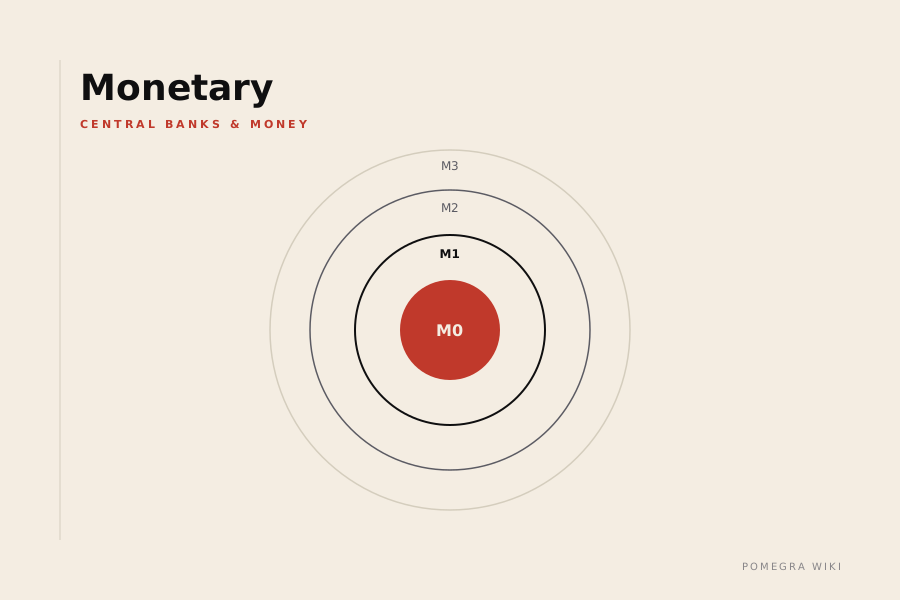
- M0 M0 is the monetary base, the most fundamental measure of money supply—cash in circulation plus reserves held at the central bank.
- M1 M1 is a measure of the money supply comprising the most liquid forms of money—cash and checking account balances.
- M1 vs M2: What the Difference Means for Savers How M1 and M2 differ in what counts as money: M1 is cash and checking; M2 adds savings accounts. Learn why the distinction matters for inflation and interest rates.
- M1, M2, and M3: Differences in Money Supply Measures M1, M2, and M3 are different monetary aggregates measuring cash, deposits, and near-money. Learn what each includes and why analysts track them separately.
- M2 M2 is a broader measure of the money supply that includes M1 plus savings deposits, money-market funds, and other near-money assets.
- M3 Money Supply M3 is the broadest measure of the money supply, including M2 plus large time deposits, institutional money-market funds, and other wide-money assets.
- M4 Broad Money The United Kingdom's widest official monetary aggregate, encompassing bank and non-bank deposits and other monetary instruments.
- Macroprudential Tools vs Monetary Policy Macroprudential tools like LTV caps and capital buffers target systemic risk, while interest rates manage inflation and employment—and they can work at cross-purposes.
Looking for something specific? Use the search box up top, or browse every category →