
561 entries
Fixed income
Treasury securities, corporate bonds, structured credit, money-market instruments, credit ratings.
- Toll Road Revenue Bonds Toll road revenue bonds are secured by traffic tolls, not taxes. Learn how coverage ratios, traffic studies, and demand elasticity affect credit risk.
- Total Return Analysis Projecting the full investment outcome by combining coupon income, reinvestment, and expected price at sale to forecast realized return.
- Tranche A slice or layer of a securitized debt pool with a specific priority in receiving payments and absorbing losses, ranked from senior (safest) to equity (riskiest).
- Transportation Revenue Bonds Bonds backed by toll roads, airports, ports, and transit revenues rather than general tax authority.
- Treasury Bill (T-Bill) A Treasury bill is a short-term debt security issued by the U.S. government, maturing in one year or less. T-Bills are issued at a discount and redeemed at face value, with the difference representing the investor's return.
- Treasury Bill Auction The mechanics of the weekly competitive-bid process through which the U.S. Treasury issues T-bills.
- Treasury Bill Discount Yield vs Coupon-Equivalent Yield Why T-bill quoted discount yields understate true returns. How to convert to coupon-equivalent yield for fair comparison with other bonds.
- Treasury Bill Discount Yield vs Investment Yield Treasury bill discount yield vs investment yield difference: why T-bills quote two yields and how to convert between them.
- Treasury Bill Laddering: How the Strategy Works How to ladder treasury bills by staggering maturity dates to balance liquidity, reduce reinvestment risk, and manage short-term cash.
- Treasury Bill Minimum Purchase: How Much Do You Need? Treasury bills have a $100 face-value minimum at TreasuryDirect; broker minimums vary. What discount pricing means for the amount you actually pay.
- Treasury Bill vs Money Market Fund Compare treasury bills and money market funds: differ in issuer, maturity, liquidity, yields, and tax status. Learn which fits your cash needs.
- Treasury Bill, Note, Bond Maturity-based classifications of US government debt securities from short (bills) to long-term (bonds).
- Treasury Bills vs CDs for Short-Term Cash Compare Treasury bills and CDs for holding cash 3–12 months: after-tax yields, liquidity, FDIC insurance, and which suits your cash runway.
- Treasury Bond A Treasury bond is a long-term debt security issued by the U.S. government with a maturity of 20 or 30 years. Bonds pay semi-annual coupons and are the longest-dated segment of the Treasury curve.
- Treasury Buyback Program A Treasury buyback repurchases outstanding government bonds before maturity to smooth cash flows and boost liquidity—distinct from QE. How it works.
- Treasury Constant Maturity Rate Explained Treasury Constant Maturity Rate: how the Fed interpolates CMT yields from on-the-run bonds and uses them in mortgage and loan pricing.
- Treasury Direct The government's retail system for buying Treasury securities directly without a broker or middleman.
- Treasury General Account The U.S. government's primary operating account at the Federal Reserve and its impact on the banking system's reserve balances.
- Treasury Inflation-Protected Securities (TIPS) TIPS are Treasury securities whose principal is adjusted for inflation based on the Consumer Price Index. They protect investors against erosion of purchasing power from unexpected inflation.
- Treasury International Capital Data The monthly U.S. report tracking cross-border capital flows into government bonds and what foreign demand reveals about Treasury market health.
- Treasury Note A Treasury note is a debt security issued by the U.S. government with a maturity between 2 and 10 years. Unlike Treasury bills, notes pay semi-annual coupons and form the middle tier of the Treasury curve.
- Treasury Note vs Treasury Bond: Key Differences Treasury notes and bonds are both US government debt, but they differ in maturity and use. Notes mature in 2–10 years; bonds mature in 20–30 years.
- Treasury Strip Separated Treasury coupon and principal traded as distinct zero-coupon instruments in the bond market.
- Tri-Party Repo A repurchase agreement structure where a third-party clearing bank manages collateral allocation and settlement between two counterparties.
- Trigger Events in Structured Finance Trigger events in structured finance are performance thresholds that automatically redirect cash flows or accelerate bond repayment when collateral deteriorates.
- True Sale Opinion A legal determination that an asset transfer to a securitization vehicle is a genuine sale, not a loan, shielding buyers from originator bankruptcy.
- Trustee Role in a Securitization Trust The trustee role in securitization involves holding collateral, distributing payments to investors, and enforcing bondholder rights when servicers fail.
- Ultra-Long Government Bond Sovereign debt with maturities of 50 to 100 years, offering high duration risk and yield pickups that appeal to long-horizon institutional investors.
- Using a Money Market Fund Inside an HSA How to hold uninvested HSA cash in a money market fund to earn yield on funds kept liquid for medical expenses.
- Variable Rate Demand Obligation A floating-rate municipal bond that allows holders to redeem at par on short notice, combining liquidity with exposure to rate changes.
- War Bond Government debt securities issued to finance military conflict, typically through mass retail campaigns appealing to patriotic obligation.
- Water and Sewer Revenue Bonds How water and sewer revenue bonds finance municipal utilities, the rate covenants that protect investors, and why they are considered a stable fixed-income sector.
- Waterfall Payment Structure The sequential order in which principal and interest cash flows from an asset pool are distributed across tranches in a securitization, prioritizing senior classes before subordinate ones.
- Weighted Average Life in Asset-Backed Securities Weighted Average Life (WAL) in asset-backed securities is the time-weighted average date on which a tranche's principal is repaid, varying with prepayment and loss scenarios.
- Weighted Average Rating Factor in CLOs WARF is a numeric measure of portfolio credit quality in CLOs, calculated from Moody's idealized default rates and used to set manager constraints.
- Weighted Average Spread in a CLO A CLO's weighted average spread sets a floor on portfolio yield and is tested as a covenant to ensure adequate compensation for credit risk.
- What Happens to a Bond Investor When an Issuer Defaults Bond recovery process: claim hierarchy, restructuring mechanics, and partial repayment scenarios for defaulted debt holders.
- What Happens to Treasury Bonds During a Recession How US Treasury prices and yields behave during recessions, and why investors flee to safety.
- What Is a BBB-Rated Bond The lowest investment-grade bond rating: what BBB means, why institutional demand is strong, and cliff risk of downgrade.
- When It Makes Sense to Sell Treasury Bonds Before Maturity How interest rate changes, rebalancing needs, and liquidity demands drive decisions to sell Treasury bonds before maturity—and how to evaluate the trade-off.
- When to Buy Bonds Strategic considerations for timing bond purchases in the context of interest rates, economic conditions, and investment goals.
- Whole-Business Securitization Explained How operating companies securitize entire revenue streams through whole business securitization structures, common in franchises and restaurants.
- Whole-Loan Securitization Converting a portfolio of whole loans into tradeable securities by pooling cash flows and selling risk tranches to investors.
- Why Bond Prices and Yields Move in Opposite Directions The inverse relationship between bond prices and yields is arithmetic: when market interest rates rise, older bonds with lower coupons become less attractive, so their market prices fall.
- Why Bonds Trade at a Premium, Discount, or Par Why bond trades at premium, discount, or par depends on the coupon rate relative to current market yields. Learn how interest rate changes affect bond prices.
- Why Credit Ratings Often Lag Market Signals Credit ratings lag the market because agencies act slowly on downgrades, relying on historical data rather than forward-looking risk; CDS and equity markets react faster.
- Why Money Market Fund NAV Stays at $1.00 The SEC accounting rules and portfolio constraints that keep money market fund NAV at $1.00 per share.
- Why the Term Premium Can Turn Negative What causes the term premium to go negative, compressing long-term yields below expected future short rates.
- Yankee Bond Dollar-denominated bonds issued by foreign corporations and sovereigns in the U.S. capital market, accessing American investors directly.
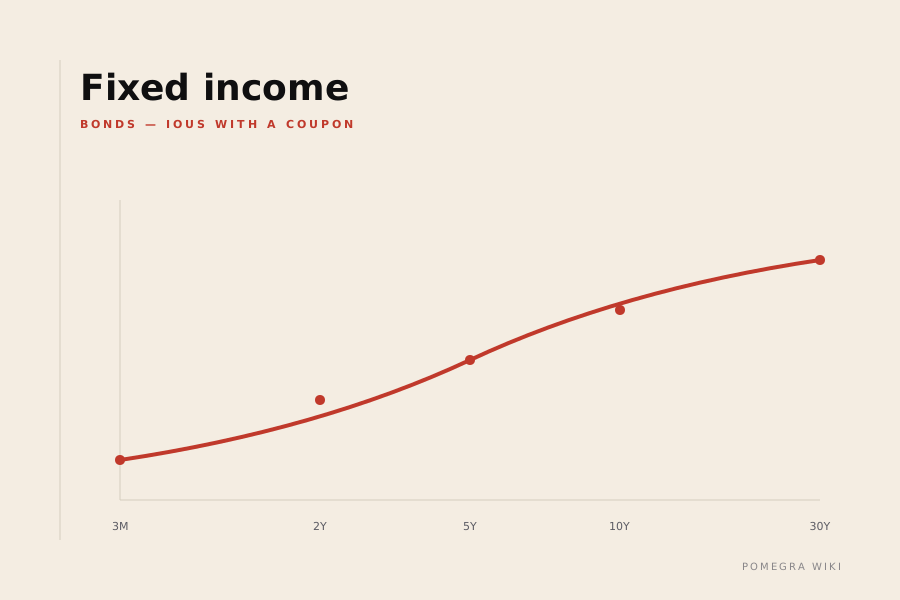
- Yield curve A yield curve is a graph of bond yields across different maturities, plotting the interest rate on the x-axis and the bond's maturity on the y-axis. An inverted yield curve (short-term rates higher than long-term rates) has historically preceded recessions.
- Yield Curve Carry Trade: Borrowing Short to Lend Long How the yield curve carry trade works: funding at short-term rates and earning long-term rates. Mechanics, profit calculation, and curve-flattening risks.
- Yield Curve Control: How Central Banks Cap Long Rates Yield curve control is a central bank policy tool that targets specific maturity yields, capping long rates to stimulate borrowing and spending.
- Yield Curve Flattening vs Steepening: Impact on Bond Math How yield curve flattening and steepening affect bond prices across maturities differently; implications for duration and portfolio risk.
- Yield Curve in Money Market Term structure of interest rates for short-maturity instruments like T-bills, commercial paper, and money market funds.
- Yield Curve Inversion When shorter-term bond yields exceed longer-term yields, signaling economic stress and potential recession.
- Yield Curve Inversion as a Recession Indicator How yield curve inversion predicts recessions: historical lead times, false signals, and the economic mechanism linking bond markets to cycles.
- Yield Curve Inversion as a Recession Signal Understand why yield curve inversion is considered a recession signal, the mechanism behind it, and the limits of using it to forecast downturns.
- Yield Curve Shape and Pension Fund Liability Matching Why pension funds are sensitive to long-end yield curve shape when discounting future liabilities, and how curve shape affects funded status.
- Yield Curve Shape Through the Economic Cycle How the yield curve shape changes across economic expansion, late cycle, contraction, and recession—and what each phase means for investors.
- Yield Curve Slope and Corporate Credit Spreads How steepness of the yield curve drives corporate bond spreads higher or lower, predicting spread compression and widening.
Looking for something specific? Use the search box up top, or browse every category →