
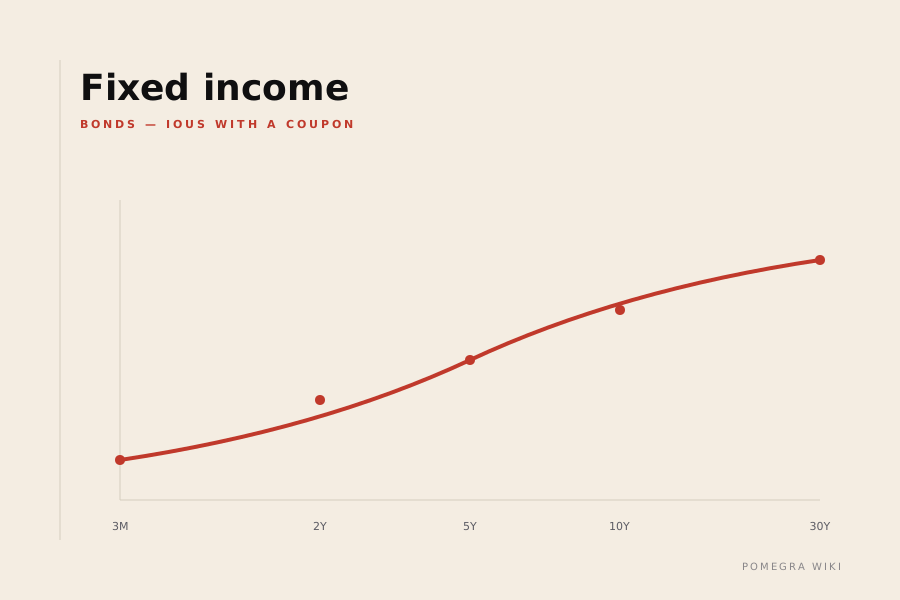
561 entries
Fixed income
Treasury securities, corporate bonds, structured credit, money-market instruments, credit ratings.
- Bond Seniority The order in which a bond's claims on a company's assets are paid in a bankruptcy or liquidation, with senior bonds paid before subordinated bonds.
- Bond Spread Over Treasury: What It Means A bond spread is the yield premium above a risk-free Treasury benchmark. Learn how spreads are quoted, why they change, and what widening or tightening signals.
- Bond Tender Offer An issuer's open invitation to repurchase outstanding bonds at a premium to par value, typically to reduce debt or refinance maturing obligations.
- Bond Tenor The original maturity length of a bond, a primary driver of yield, liquidity, and investor appeal.
- Bond Yield Curve Risk The risk that changes in the shape of the yield curve will reduce bond portfolio values, particularly from non-parallel shifts.
- Bond Yield Spread The difference in yield between two bonds, often used to compare bonds of different maturities, issuers, or credit qualities.
- Bond-Equivalent Yield A standardized yield measure that converts Treasury bill returns to a semi-annual compounding basis, making them comparable to bond yields.
- Bootstrapping the Spot Rate Curve: A Worked Example Step-by-step guide to deriving zero-coupon spot rates from par-priced coupon bonds through bootstrapping spot rate curve calculations.
- Bootstrapping the Yield Curve Deriving zero-coupon spot rates sequentially from coupon-bond prices using no-arbitrage logic.
- Bootstrapping the Yield Curve The sequential method for extracting zero-coupon spot rates from observable coupon bond prices.
- Breaking the Buck: When Money-Market Funds Fall Below $1 NAV What does breaking the buck mean in a money-market fund? Explains when NAV drops below $1.00, triggers, and investor impact.
- Brokered Deposit Funds placed by a broker across multiple banks to maximise FDIC insurance coverage and yield, a practice regulators monitor for systemic risk.
- Build America Bonds A 2009 federal program that subsidized the interest on taxable municipal bonds to lower borrowing costs for public infrastructure.
- Bull Flattener A yield curve shift where short-term bond yields fall faster than long-term yields, narrowing the maturity spread and lifting bond prices, especially at the long end.
- Bull Steepener: Causes and Bond Market Implications A bull steepener widens the yield curve as long-term rates fall faster than short rates. Learn what drives it and why it favors long-duration bonds.
- Bullet Bond vs Amortizing Bond Bullet bonds repay all principal at maturity; amortizing bonds repay principal in scheduled installments. Learn how each affects duration, reinvestment risk, and cash flow.
- Butterfly Shift A yield curve movement where short and long-term rates change more than medium-term rates, creating a concave dip or bulge in the curve.
- Buy-and-Hold Bond Strategy An investment approach where bonds are purchased and held to maturity, ignoring interest-rate fluctuations and secondary-market prices.
- Call Money Market The overnight interbank lending segment where banks and brokers borrow funds repayable on demand, primarily used to finance margin lending to investors.
- Call Premium on Corporate Bonds Explained What a call premium on a corporate bond is, why issuers pay it when redeeming bonds early, and how to calculate adequate compensation for reinvestment risk.
- Callable Bond A callable bond is a debt security that the issuer can redeem before maturity, typically when interest rates fall and the issuer can refinance at lower cost.
- Callable Bond Mechanics: How Call Provisions Work Learn how callable bonds work, when issuers exercise call options, and how call risk affects pricing and reinvestment.
- Callable Municipal Bond Explained What callable municipal bonds are and how call provisions work. Learn why issuers embed call options and how call risk affects your realized yield.
- Capital Appreciation Bond A zero-coupon municipal bond where accrued interest compounds until maturity and is paid in a single lump sum, rather than periodically.
- Cash Flow CDO A collateralized debt obligation whose viability rests on the steady coupon and principal payments of its underlying assets, independent of market price movements.
- Cash Flow Yield The internal rate of return on a mortgage-backed or asset-backed security given an assumed prepayment rate.
- Cash Management Bill Irregular, short-dated Treasury bills issued off-cycle to bridge near-term government cash shortfalls.
- CD vs Treasury Bill After-Tax Yield Comparison How Treasury bills escape state income tax while CDs do not, and how to calculate the after-tax equivalent yield to compare returns across tax brackets and states.
- Certificate of Deposit (CD) A certificate of deposit is a bank-issued savings instrument that pays a fixed rate of interest on a deposit for a specified term.
- Certificates of Participation Municipal securities backed by lease payments rather than direct bonding authority, allowing public entities to finance capital projects without voter approval.
- Change-of-Control Put A bondholder right to force the issuer to repurchase the bond at par value upon an acquisition or significant ownership change.
- Clean Price vs Dirty Price at Settlement Clean price vs dirty price at bond settlement: why investors pay accrued interest on top of the quoted price.
- Clean Price vs. Dirty Price Why bond prices quoted in markets exclude accrued interest, while settlement prices include it.
- Clean-Up Call Option granted to the servicer of a mortgage-backed security to redeem remaining securities when the pool balance drops below a specified threshold.
- CLO Equity Tranche Returns Explained How CLO equity tranches capture residual cash flows, why returns vary widely, and what drives outperformance or losses in this most-junior tier.
- CLO Manager Fees Explained CLO managers earn a senior fee paid off the top and a subordinated fee only when equity clears its hurdle. How the fee waterfall aligns incentives.
- CLO Reinvestment Period vs Amortization Period How CLO portfolio shifts from active loan reinvestment to passive wind-down, reshaping cash flows and risk.
- CLO Reset vs Refinancing A CLO reset extends the reinvestment period and reprices the whole stack; a refinancing replaces specific tranches' debt. When each makes economic sense.
- CLO Tranche Dynamics Waterfall payment priority and credit enhancement across tiers in collateralized loan obligation tranches.
- Collateral Manager Asset management firm with discretion to trade the loan portfolio inside a CLO within eligibility constraints, protecting yield and ratings.
- Collateralized Debt Obligation (CDO) A collateralized debt obligation is a complex securitized instrument backed by a pool of bonds or loans. CDOs are structured with tranches of different risk levels.
- Collateralized Loan Obligation (CLO) A collateralized loan obligation is a securitized debt instrument backed by a pool of corporate loans, typically leveraged loans from private equity buyouts.
- Commercial Mortgage-Backed Security (CMBS) A commercial mortgage-backed security is a debt instrument secured by a pool of commercial real estate mortgages. CMBS pools include office, retail, industrial, and multifamily properties.
- Commercial Paper Commercial paper is short-term, unsecured debt issued by corporations to fund immediate working capital needs. Maturities are typically 1–270 days.
- Commercial Paper Conduits in Securitization How ABCP conduits fund long-term assets with rolling short-term commercial paper, and their role in the 2007–08 financial crisis.
- Commercial Paper Credit Ratings and Default Risk How credit ratings assess commercial paper programs, what ratings money-market funds require, and historical default frequency in short-term debt markets.
- Commercial Paper vs Treasury Bills: Risk and Yield Trade-Off Comparing commercial paper and T-bills for short-term investors: safety, liquidity, yield spreads, and the default risk trade-off.
- Competitive vs Noncompetitive Bids at Treasury Auctions How retail investors use noncompetitive bids to guarantee allocation, compared to dealers' competitive bidding.
- Conditional Prepayment Rate (CPR) Explained Conditional Prepayment Rate (CPR) is an annualized measure of how fast borrowers prepay loans. It converts monthly prepayment speed (SMM) into a yearly percentage used to project bond cash flows.
- Conduit Bond A bond issued by a government authority on behalf of a private borrower, allowing the borrower to access tax-exempt capital while the government retains nominal issuer status.
- Consequences of a Bond Being Downgraded to Junk When a bond loses investment-grade status, forced selling cascades through the market—fund mandates shift, indices exclude it, and liquidity evaporates.
- Consol Bond A perpetual British government bond paying coupons forever with no maturity date; the canonical example of perpetual debt.
- Continuing Disclosure Agreement An SEC Rule 15c2-12 obligation requiring municipal bond issuers to file annual financial statements and material-event notices, ensuring that bondholders receive ongoing information after purchase.
- Convertible Bond A convertible bond is a debt security that can be converted by the holder into a predetermined number of shares of the issuing company's common stock.
- Converting Bank Discount Yield to Investment Yield Step-by-step formula to convert T-bill and banker's acceptance quotes from bank discount yield to bond-equivalent (investment) yield basis for fair comparison.
- Convexity Convexity is the degree to which the relationship between bond prices and yields is curved. Positive convexity means bonds gain more from falling rates than they lose from rising rates.
- Convexity Adjustment for Large Yield Changes Why linear duration approximation fails for large yield moves, and how convexity corrects bond price forecasts.
- Convexity Adjustment: Improving Duration-Based Price Estimates Convexity adjustment refines bond price estimates by correcting for the curvature that duration alone misses in large yield movements.
- Corporate Bond A corporate bond is a debt security issued by a company to raise capital. Bonds pay fixed or floating coupons, mature over time, and carry credit risk reflecting the issuer's ability to repay.
- Corporate Bond Bid-Ask Spread Explained Why corporate bond bid-ask spreads are wider than equities, how dealers price them, and how TRACE data reveals your real transaction costs.
Looking for something specific? Use the search box up top, or browse every category →