
561 entries
Fixed income
Treasury securities, corporate bonds, structured credit, money-market instruments, credit ratings.
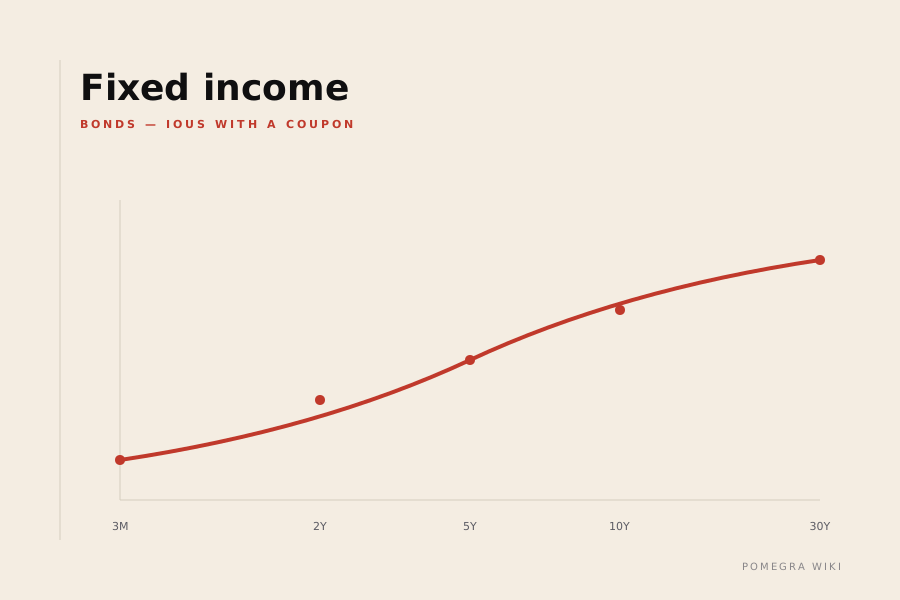
- Yield Curve Steepness as a Recovery Signal Why a steep yield curve typically follows recessions and what historical evidence shows about upward-sloping curves as a signal for economic recovery and growth.
- Yield Curve Twist: When Short and Long Rates Move in Opposite Directions A yield curve twist occurs when short and long-term bond rates move in opposite directions. Learn how this differs from parallel shifts and why it matters.
- Yield Pickup The incremental yield gained by swapping from one bond into a higher-yielding substitute—a staple of portfolio management.
- Yield Spread Measures Methods for quantifying the excess yield on a corporate bond relative to its benchmark, accounting for embedded options and curve shape.
- Yield to Call Yield to call is the return an investor earns on a callable bond if it is called before maturity and redeemed at the call price.
- Yield to Call vs Yield to Maturity: What Callable Bond Investors Need to Know How yield to call differs from yield to maturity for callable bonds and why the lower number is the conservative return estimate.
- Yield to Call: How to Calculate It for Corporate Bonds Yield to call is the annualized return if a bond is redeemed at its first call date; calculation is identical to yield to maturity but uses call price and call date.
- Yield to Maturity (YTM) Yield to maturity is the total return an investor earns on a bond if it is held to maturity, accounting for coupon payments and the difference between the purchase price and face value.
- Yield to Maturity vs Current Yield: Key Differences Yield to maturity and current yield are two distinct measures of bond returns; YTM assumes you hold to maturity and includes capital gains/losses, while current yield ignores them.
- Yield to Maturity: Semiannual vs Annual Compounding Understand why yield to maturity differs with semiannual vs annual discounting, and how to convert between the two compounding conventions.
- Yield to Put The yield an investor receives if they exercise a put option embedded in a bond at the earliest opportunity.
- Yield to Worst The lowest possible yield an investor can receive on a callable or putable bond, accounting for all early-redemption scenarios.
- Yield to Worst on a Callable Bond Yield to worst on a callable bond accounts for call risk. Learn why it's the most conservative yield metric and how to calculate it across multiple call dates.
- Yield to Worst on Corporate Bonds Yield to worst is the lowest yield a bondholder can earn if the bond is called, put, or matures early. It matters more than yield-to-maturity for callable corporate bonds.
- Z-Bond An accrual tranche in a collateralized mortgage obligation that receives no cash payments until all senior tranches are fully retired, with accrued interest added to principal.
- Z-Spread The constant basis-point spread added uniformly to every point on the Treasury spot curve so a bond's discounted cash flows match its market price.
- Z-Spread vs OAS: What the Difference Reveals Z-spread vs OAS difference: OAS strips embedded option value from Z-spread, isolating true credit and liquidity risk in callable and putable bonds.
- Zero-Coupon Bond A zero-coupon bond is a debt security that makes no periodic interest payments and instead is sold at a deep discount to its face value, with the entire return realized at maturity.
- Zero-Coupon Bond Economics No interest payments; pure discount instrument sold at deep discount to face value.
- Zero-Coupon Corporate Bond A corporate bond that makes no periodic interest payments but instead is sold at a deep discount and repays par value at maturity.
- Zero-Coupon Yield Curve Construction Zero-coupon yield curve construction extracts spot rates from coupon bond prices using bootstrapping, revealing the true discount rate for any maturity.
Looking for something specific? Use the search box up top, or browse every category →